

Continental Drift
An interview with Mai-Linh Hong by Leona Sevick


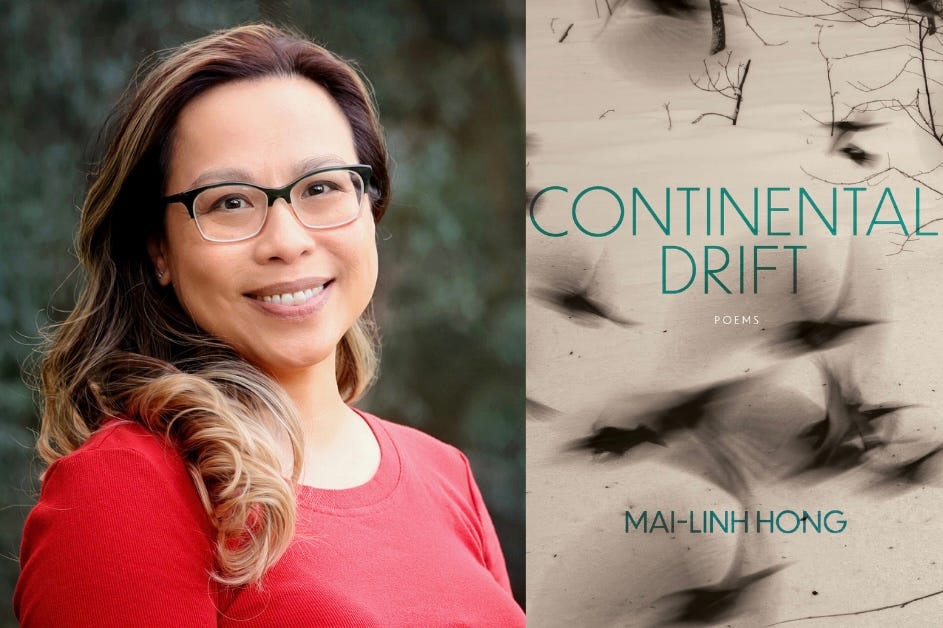
Mai-Linh Hong’s debut poetry collection, Continental Drift, won the 2025 Trio Award and will be published by Trio House Press in July 2026. She has been a Voices of Our Nation Fellow, Tin House Scholar, and Susanna Colloredo Fellow in Environmental Writing at the Vermont Studio Center. Her research has been supported by fellowships from the American Council of Learned Societies, American Association of University Women, Institute for Citizens & Scholars, and more.
Dr. Hong’s research on Asian American and refugee literatures can be found in Amerasia Journal, Verge, MELUS, and other journals and edited volumes. A lifelong crafter and sewist, Dr. Hong is coauthor and coeditor of The Auntie Sewing Squad Guide to Mask Making, Radical Care, and Racial Justice (University of California Press, 2021).
Her poems appear or are forthcoming in Ploughshares, Copper Nickel, Waxwing, The Offing, and numerous other journals and in They Rise Like a Wave: Anthology of Asian American Women Poets (Blue Oak Press, 2022). She was a finalist for the Test Site Poetry Series, the Graybeal-Gowen Prize, and Best of the Net, and a runner-up in the Hayden’s Ferry Review Poetry Contest.
Leona Sevick: You were trained as a literary scholar and you also earned a JD, but have you always written poetry? And how has your poetry been informed by your training and teaching as a literary scholar?
Mai-Linh Hong: Yes, thanks for that question. I mean, I make jokes about how often I returned to school, but you know, it all comes together at some point. I have written poetry, actually, since I was a child. I would say I have not viewed poetry as part of my professional profile, until very recently. These fields or disciplines, literary studies and law, they’re called disciplines for a reason. They discipline you into certain ways of thinking and writing. On one hand, both fields exposed me to a wide range of other writers, and that has been, in a way, my training in creative writing, just being exposed to so many different writers, and as a teacher as well, reading and teaching so much poetry over the years. But on the other hand, it can impede your creative process. Interestingly, in the last few years, I did have a chance to step away from research for a bit. I had a fellowship for a year, and then, as life does, life threw some curve balls at me, and I had a period of medical leave where I wasn’t able to do my research. But this actually made space for me to go back to an earlier version of myself as a thinker and as a creator, and that’s when I started writing poetry in a more concentrated way. I started thinking of it as a project and not just as a private practice that I did for myself and maybe read to a few friends, but didn’t, you know, put out there in the world. Most of this book was written within a period of about six months. Yeah, it is intense. And I think it took a lot of months of clearing my mind before that could happen. So on one hand, I think the literary studies training can be really good training as a poet, but on the other hand, you have to turn off that critical voice. I’d be curious at some point to hear about your training….
LS: Yeah. My training has been similar. I didn’t go to law school, though. I don’t have that, but I started writing very late, so that wasn’t something that was really part of my life for a long time, but once it was, I didn’t turn back.
MH: Yeah, there’s been a joy in returning to an earlier, more creative part of myself.
LS: That’s great. And boy, you had a lot of productivity in a very concentrated amount of time. And that’s a gift! And you’d had much success with this book. Congratulations!
MH: Thank you.
LS: I wanted to ask you about the poems that engage the Vietnam War and your experience as a child refugee. As a result, the perspective or point of view of the child occurs often in your work. Can you talk a little bit about the experience of writing from that viewpoint?
MH: I’ve had time and space to consider my own upbringing in the last several years, in conjunction with raising my son, who is nine. He was very young during Covid, for example, which was a time when I think a lot of people got introspective, not having the same external social relations that they usually had. For myself as well, it was a time to reflect on who I am as a parent. And that led me to think a lot more about my childhood. And so it makes sense to me that these poems came after that period.
It’s also interesting when you come from a refugee background or any background that involves a lot of trauma or intergenerational memories or big experiences to contend with. It’s almost like you have to deal with that before you can get to other topics. You know, I talked to other writers who are Vietnamese or have similar backgrounds, and they also feel sometimes like, well, I had to write the refugee poems first before I could write the poems that are about other things. I think there’s some amount of that. And I think that part of the narrative arc of this book is moving from that place of like, what happened? Where did I come from? How did I land here? Like moving from that place, to a place of greater possibilities. And so by the end of the book, I think I’m very much in the present moment and thinking about how to live ethically as a human, you know, with the afterlife of refugee migration always informing it, of course. But I think there’s an intertwining of thinking about parenting and thinking about my own childhood. I think it comes up for a lot of folks when they have a young kid, too.
LS: I think so, yeah, we can’t help but reflect in that way. And I love that your title also reflects the sort of shift that you describe: the refugee poems and then a move into a different space. I think that’s very good.
So many of your poems pursue very personal losses. Are these poems difficult to read or to discuss publicly?
MH: Yeah, thank you for asking that. So I think grief showed up in this collection much more than I expected. And maybe that happens naturally, I don’t know. Reflecting on my family history and my childhood, the grief of growing up in a separated family—a family that had gone through involuntary migration, where branches of the family couldn’t access each other—growing up in that kind of environment became much more visible to me over the course of writing these poems. And the grief of that came out in the poems and maybe enabled me to access certain other experiences.
So I do write about my miscarriages and infertility in this collection. It’s not that I set out to do that, and I didn’t set out to write about any particular topic in this collection, but I do think that once grief was on the table, it allowed me to talk about things that had been really difficult to discuss before. I have not publicly talked about having multiple miscarriages and struggling with secondary infertility after I had my son; that’s something most of my colleagues won’t know about me, right? And it’s not something that I’ve written about in a scholarly way. I think the poems are probably my best way to talk about it at this point.
READ THE FULL ANSWER TO THIS QUESTION IN THE FULL INTERVIEW HERE.
LS: I want to ask a question that relates to that point. So I very much enjoy the way you take unlike topics and you sort of, you know, push them together in surprising ways in your poems, as in the poem you just described. You do this also in the “Casey Kasem and the Cannibals” poem, which yokes the rumor of cannibalism among boat people to motherhood. I thought that was fascinating. How do these poems come together in your writing, and how do they begin?
MH: Thank you for that. I think it’s a product of associative thinking and the freedom that poetry gives you to follow lines of thought your brain might put together but not tell you why. As a scholar, you’re not supposed to really pay that much heed, right? You’re not supposed to follow what look like tangents. You’re supposed to have really good transitions when you write an academic article, right? But with poetry, I can trust the association, even when I might not know where it’s headed. So I might start a poem thinking it’s about one thing, and then some other image or situation occurs in the poem, and I have no idea why, but I just go with it, and then somehow it comes back together. And I know that my brain had made connections and it just hadn’t made them in an order that was totally visible to me. And so I’ve learned in poetry writing to just go with it, and things that that want to be together end up together.
Sometimes I have a certain image or idea that’s tumbling around in my mind over days or weeks, and then there’s something else close in time that’s doing the same. Then at some point, I put them together to see what happens, and I realize they’re really about the same thing in some way, right? That there’s a connection there. That’s how those poems happen. I don’t think I’m curating the topics and intentionally putting them together, but I try to trust my gut and allow them to come together. I think you had another question, which I really appreciated, about form and the shapes of poems. I think it’s a similar thing. There’s an intuitive aspect to it. Sometimes one image wants to be next to another image. Sometimes certain lines want to be on the page in a particular physical or visual way; they want to use the space in a particular way. And sometimes I write a poem out in words knowing it’s not in the shape it’s supposed to be in, and it’s during the revision process that it finds its shape. And I might have to try out a few things before something feels right.
READ THE FULL ANSWER TO THIS QUESTION IN THE FULL INTERVIEW HERE.
LS: Coherence is a kind of guardrail that you have to attend to, even if you want to play. So I feel that absolutely. Could you talk a little bit about whose work has influenced your writing and in what ways?
READ THE ANSWER TO THIS QUESTION IN THE FULL INTERVIEW HERE.
LS: I think when you study literature and you write in that way, sometimes it can feel intimidating, because you’ve read things and you do have an aesthetic sense, and you have this sort of bar that you set in your mind, and it’s hard to live up to that. Sometimes it’s very hard to live up to that. I used to tell people that I didn’t write poetry because I read and taught so much of it, and I thought, what could I write to add to the conversation? But of course, you find things that other people connect with.
So my last question to you is, what are you working on now? Now that the book is out there and you’re talking about the book and reading from it. Are you taking a break from writing, or are you working on another project?
MH: I am slowly working on another project. Teaching is hard for me to juggle with writing, and now that the semester is wrapping up, I’m hoping to get back to a more regular writing practice.
I finished Continental Drift a little over a year ago, while at a residency at the Vermont Studio Center. During the first half of the residency, I finished my revisions, submitted it to Trio House and a couple other places, and then the rest of the residency, I wrote new work. I remember thinking to myself, this is a new project. The work I wrote in the second half of the residency felt different and was different in form. I was leaning more into form, inherited forms and techniques like the American sonnet and erasure and certain other forms. I was writing more directly about political issues that were on my mind because of the moment that we’re in, probably. Also, like what I said before, there’s a sense that certain things I had to say, I was able to say in Continental Drift, which enabled me to turn a fresh page, to address other topics—there’s a bit of a clean slate.
I have been writing a series of American sonnets. It’s influenced by work by Wanda Coleman and Terrance Hayes, non-rhyming sonnets that are playful and in a mixture of emotional registers, and sometimes very directly critical of political issues. The sonnet form has a rhetorical structure that has allowed me to process in manageable-size pieces what we’re experiencing as a nation. And maybe it has appeared to me as a useful prism for apprehending the extreme losses and trauma that we’re seeing in the news.
LS: Do you engage with the volta? Do you have turns in your sonnets?
READ THE ANSWER TO THIS QUESTION IN THE FULL INTERVIEW HERE.
LS: Well, that sounds exciting. I can’t wait to see those poems.
MH: Thank you.
 | A guest post by
|