

Dear Dear
An interview with Reuben Gelley Newman by Samantha Hernandez

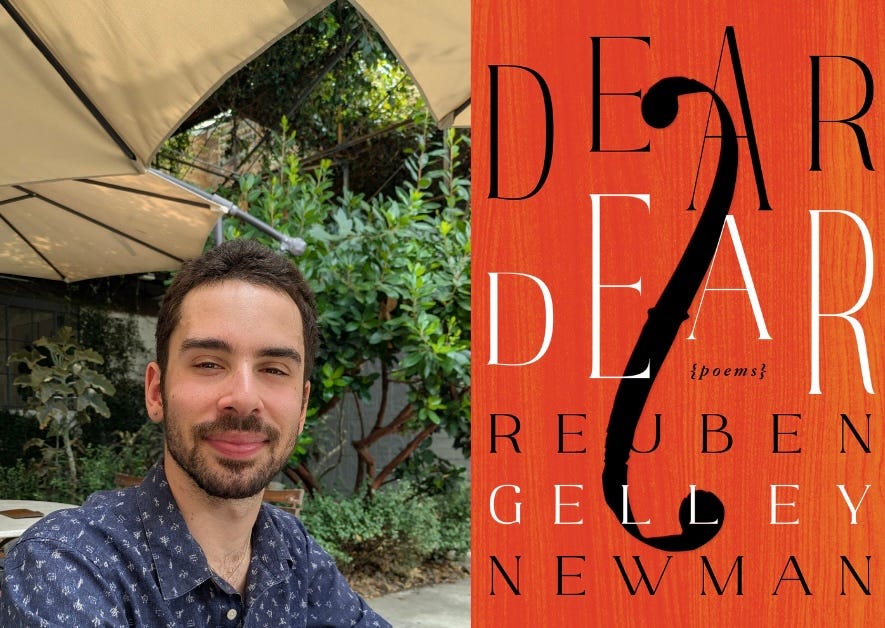
Reuben Gelley Newman (he/they) is the author of Dear Dear (Trio House Press, 2026), winner of the 2025 Louise Bogan Award, judged by Randall Mann. They also wrote a chapbook, Feedback Harmonies (Seven Kitchens Press, 2024), in homage to the musician Arthur Russell. Reuben is a writer, musician, editor, reviewer and librarian based in New York City. Their poems have appeared in Denver Quarterly, Salamander, Fairy Tale Review, Northwest Review, Ninth Letter, and elsewhere. You can find them online @joustingsnail (Instagram, Twitter); on Bluesky, they post at @joustingsnail.bsky.social.
I had the pleasure of acting as a secondary editor on Reuben Gelley Newman’s forthcoming book of poetry and the Trio House 2025 Louise Bogan Award-winning manuscript, Dear Dear.
Before its release, Reuben chatted with me about his influences, process, and the value of cannon-clashing.
Samantha Hernandez: Having witnessed some of the process of your manuscript editing, I’m very excited to talk to you about your forthcoming book!
Something I really love about your work is how many references you include. You mash up pop stars like Mitski with historic figures like Bach and mythic figures like Poseidon. I was wondering if you could tell me about your thoughts on mythmaking and world-building and your writing process.
Reuben Gelley Newman: I was talking a little bit the other day with a friend, another poet, Ty Raso, and she brought up the phrase canon-clashing, which I thought was really interesting. That phrase fits with some of the poems where I put Bach and Mitski together. I have another one that references both Lorde and Vivaldi.
In terms of mythmaking more broadly, I’m interested in puncturing myths a little bit. I’m interested in thinking about how we remember these figures, like Bach, who has a mythic stature in Western classical music.
READ THE FULL ANSWER TO THIS QUESTION IN THE FULL INTERVIEW HERE.
SH: You make frequent use of apostrophe in your poetry, particularly with regard to Russell and Eastman. As a musician and a poet, yourself, what does it feel like to address these figures? How do you make it personal?
RGN: Apostrophe is in some ways a way to make it personal, like a formal method to do so, to connect the musician’s life. If I’m writing about a musician, I’m writing with my own experience of listening to their music.
It’s a tricky thing, because earlier drafts of the manuscript were more solely focused on Russell and Eastman. I was connecting with people who aren’t alive right now, who lived in very different times and places, who have different backgrounds, which is always tricky, and fraught in its own ways. It has to reside in my own connection to the music and that has to be the crux of it. I don’t want to be analyzing music. That’s not what I’m trying to do.
What I am trying to do is evoke the music’s emotions and evoke a story as well, whether it’s my own speaker’s stories, their own tellings of their stories, or thinking about other people, either other artists who have told their stories or people who have helped recover and share their music. In the case of Russell and Eastman, for instance, there’s Tom Lee, Arthur Russell’s partner, and Audika Records, which has released Arthur Russell’s music, and many different people who have helped recover Julius Eastman’s music. Mary Jane Leach is another person who saved scores of Julius’s and then brought them back to light.
There’s so much there. And it’s about what’s personal between me and the artist, but also community and thinking about broader artistic communities that others live in and that I live in as well.
SH: You reference these artistic figures and different historical times, including the AIDS crisis and the COVID-19 pandemic, as well as the Pulse nightclub shooting. It’s apparent that you’re not shying away from current events in your work. I wanted to ask you about your feelings on incorporating activism in poetry.
RGN: The poetry world, as a whole, publishes amazing work, poems that express great things and have great political urgency and necessity, but I’m not sure that for the most part, it functions as activism.
Whether it’s activism or not, it’s really important to address current events and everything going on in the world around you, whether that’s a poetry of nowness, to some extent, or poetry of just noticing and being aware of my own place in the world as well. It’s complex. It’s important to do, and important to try to do it from an honest and open place, not a place where you’re trying to witness in a way that makes it about yourself.
I don’t want to make any of the current events that I don’t necessarily have personal stake in about myself. Even though I’m a queer man, for instance, I’m not in the same places of danger that people in the Pulse nightclub shooting were. Political experience and identity, and identity as an activist span a lot of ranges.
It’s important to come from a place of honesty and just figuring out what you can do. That’s partly a process that helps with the poems but also thinking about community and friendship within all of the political crises that we see around the world.
SH: Many of your poems are reflective. They reflect on the process of writing, but there’s also a sense of obligation or commitment to the poem, or more specifically a tending. You write that you “want the husband of the song.” Could you tell me more about that?
READ THE ANSWER TO THIS QUESTION IN THE FULL INTERVIEW HERE.
SH: You’re writing about queerness and desire, but you’re also talking about these historical figures and these musicians. You’re also talking about your family and your own experience in the world. That reminds me, the term rhizomatic appears in your work. And I was wondering if you could tell me a little bit more about that idea.
READ THE ANSWER TO THIS QUESTION IN THE FULL INTERVIEW HERE.
SH: You’re a musician and a poet. I’m just curious about how those two art forms influence each other. How does your writing influence your music, and the other way around?
RGN: I don’t necessarily think of myself as an active professional musician. I’m not making songs much outside of the poems. I mean, I hum to myself, whistle to myself, sing to myself, and I’ll fiddle around on the piano. I’m often just playing things that are previously written.
It’s more about the music influencing the poetry than the poetry influencing the music. I’m always thinking about the sound of a poem and that’s whether I, however often I read stuff aloud, while revising, I’m not sure if I do that all the time. Regardless, it’s in my head there.
READ THE FULL ANSWER TO THIS QUESTION IN THE FULL INTERVIEW HERE.
SH: You also include personal history and family in your poems in addition to your poetic and musical influences.
RGN: I do talk about family and friendship a bit, too, in these poems. It’s important, even as I’m honoring a lot of different figures who I didn’t know, to acknowledge everyone in my life.
My grandma, whose art making has inspired some of my work. I mean, my mom’s an art teacher as well. My dad’s an English professor.
There’s a lot in my family background that has contributed to my development as a writer. And I’m grateful to all my friends as well, whose writing inspires my own.
SH: What is something that you’ve discovered through the process of making this book, either about yourself or your process?
RGN: My art process can be somewhat chaotic. The manuscript itself came together over the course of a few months from different projects that I had had already. It was an emotionally chaotic time in some ways.
And in terms of work as well, I was writing some new stuff that I put into the book. Some of the more political poems and the seasonal poems -- those all came together alongside the political content. I thought, I want to put this conversation with previous work, the title poem of the collection, Dear Dear, and the more musical and ekphrastic poems.
So, the book is a composite of sorts. And my process can be variable. Some poems will come together quickly; other poems will take a while to revise. Some themes will really grab me, and I’ll be very focused on them. That’s apparent through the book, too, in terms of thinking through obsession.
That reflects some level of ADD that I have, which is an awareness that writers work in a lot of different ways, and it might not always make sense for people to have regular routine writing practice, like writing every day.
I’m happy when I want to write and when I have space to write. If I develop regularity at some point, that’d be great. But I’m also interested in seeing what can come from chaos or counterpoint, to use a musical metaphor.
Interesting to hear your thought process around what went into the manuscript as more work kept coming, Reuben.
Love that you balance irony and earnestness; it helps get closer look to the truth, and it’s something I’m trying to balance in my own writing.
I also love the idea of canon-clashing, especially between classical and pop. Myths hold weight because they are still easily noticed and representative in our modern political and idolatry culture.
Looking forward to receiving my copy of Dear Dear!