

FULL INTERVIEW: Dear Dear
An interview with Reuben Gelley Newman by Samantha Hernandez

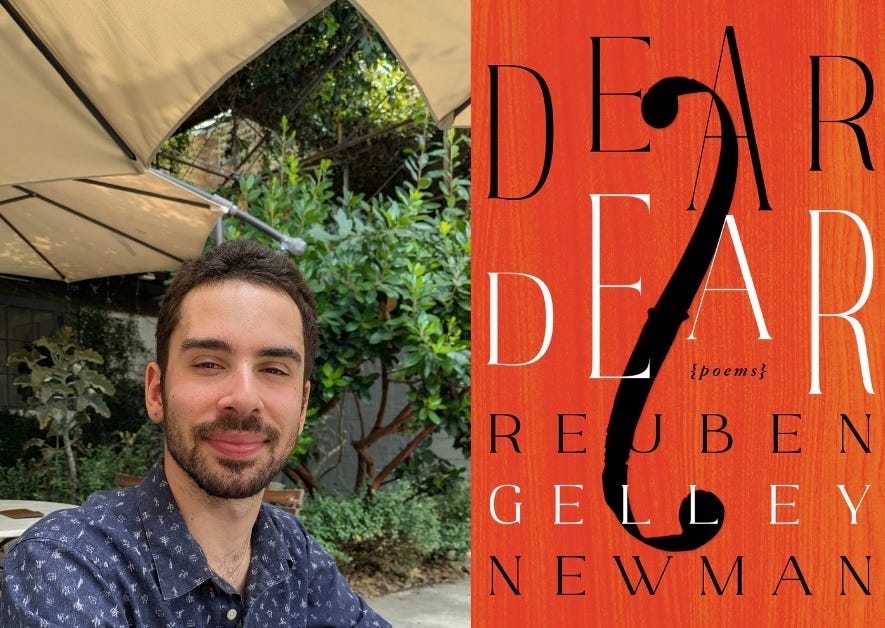
Reuben Gelley Newman (he/they) is the author of Dear Dear (Trio House Press, 2026), winner of the 2025 Louise Bogan Award, judged by Randall Mann. They also wrote a chapbook, Feedback Harmonies (Seven Kitchens Press, 2024), in homage to the musician Arthur Russell. Reuben is a writer, musician, editor, reviewer, and librarian based in New York City. Their poems have appeared in Denver Quarterly, Salamander, Fairy Tale Review, Northwest Review, Ninth Letter, and elsewhere. You can find them online @joustingsnail (Instagram, Twitter); on Bluesky, they post at @joustingsnail.bsky.social.
I had the pleasure of acting as a secondary editor on Reuben Gelley Newman’s forthcoming book of poetry and the Trio House 2025 Louise Bogan Award-winning manuscript, Dear Dear.
Before its release, Reuben chatted with me about his influences, process, and the value of cannon-clashing.
Samantha Hernandez: Having witnessed some of the process of your manuscript editing, I’m very excited to talk to you about your forthcoming book!
Something I really love about your work is how many references you include. You mash up pop stars like Mitski with historic figures like Bach and mythic figures like Poseidon. I was wondering if you could tell me about your thoughts on mythmaking and world-building and your writing process.
Reuben Gelley Newman: I was talking a little bit the other day with a friend, another poet, Ty Raso, and she brought up the phrase canon-clashing, which I thought was really interesting. That phrase fits with some of the poems where I put Bach and Mitski together. I have another one that references both Lorde and Vivaldi.
In terms of mythmaking more broadly, I’m interested in puncturing myths a little bit. I’m interested in thinking about how we remember these figures, like Bach, who has a mythic stature in Western classical music.
I have a poem, that’s the last poem in the book, talking about how Bach composed a musical offering for Frederick the Great of Prussia, who, as a royal, is a mythic figure in his own right. There are rumors of — probably more than rumors — some evidence of him being in same-sex relationships. But then I have a line, “Frederick the Great was gay?” At the last minute, even after the editing finished, I added a question mark after that as a way to puncture the myth a little bit. I’m also interested in working through myths, especially in the case of musicians that I’m writing about, like Arthur Russell and Julius Eastman, where I’m thinking about nostalgia and how we make myths out of figures whose public memory is fraught, or is coming back after decades.
SH: You make frequent use of apostrophe in your poetry, particularly with regard to Russell and Eastman. As a musician and a poet yourself, what does it feel like to address these figures? How do you make it personal?
