


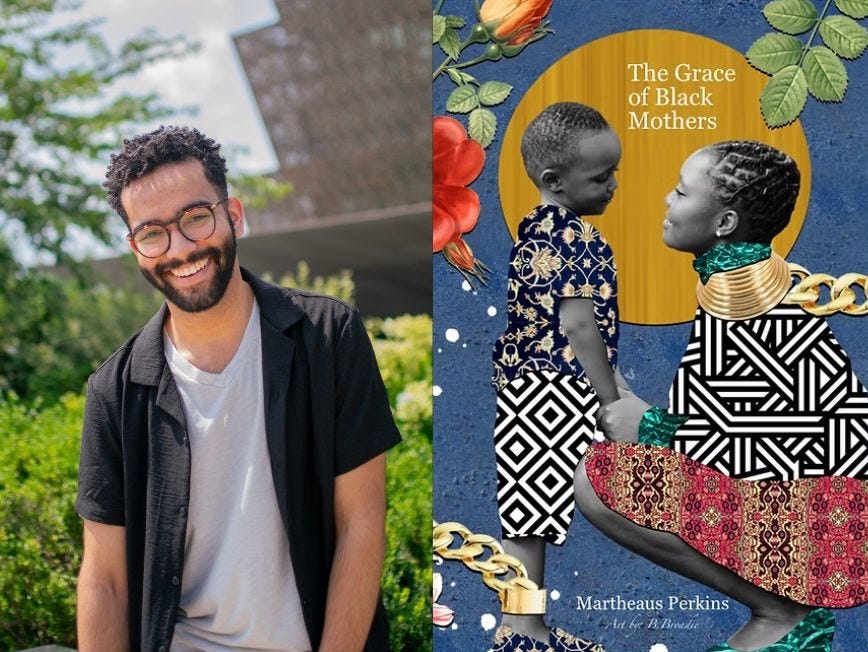
Martheaus Perkins writes poetry, fiction, and creative nonfiction. He is a teacher, editor, and hot sauce enthusiast living in Virginia. The Grace of Black Mothers, his debut poetry collection, is forthcoming from Trio House Press. He is the recipient of the Robert Creeley Memorial Award, judged by John Keene, the President’s Award by Voices, the GMU Rinehart Fiction Award, and the Robert Raymond Scholarship. He co-edits BRAWL Lit and teaches literature at George Mason University.
Alliyah Shafer: How did you get into poetry (reading and writing)?
Martheaus Perkins: I have a weird origin story. I was always a slow reader because I loved the words and comprehension, for whatever reason. So for that reason, I never read Harry Potter because it was too large. I never read any of those big chapter books. I would always read poetry books because I liked that I could have something thick in my hands and feel like I was keeping up with the other kids at my reading level.
The first poem I ever wrote, I was fourteen. I wrote it after hearing about a case of a kid named George Stinney. George Stinney was a young African American boy killed by the state by electric chair. The details of the story were quite gruesome, and I remember I watched a video about it on YouTube. I was fourteen years old hearing this story about another kid who was fourteen years old being killed in an electric chair. It spurred me. I don’t remember what the poem was about, but I remember the title, “The White Sea,” and I wrote this rhymed poem about my anger hearing about this case.
When I got to undergrad, in a creative writing class because it’s one of the mandated electives for English teachers, that’s what I wanted to do, I wanted to be an English teacher. I found myself almost, it didn’t feel like I was meeting myself for the first time. It felt like my imaginary friend was made tangible. I felt like I’ve always had this childhood love. When I was spurred to write something, I would write it within line and rhyme. Once I got to a class where, ‘Oh my God, you’re telling me I can write? And I don’t have to do equations?’ I thought, this is what my life is now. I’m going to do this for a living.
AS: This book includes quite a few images, mostly of your mother and grandmother, as well as diverse forms (pros/cons list, scene play script, timeline, notebook draft, quiz, tv guide, venn diagram, letter). Why did this book need to be multimedia for you?
MP: I remember my favorite class was English, and we were taught that basically our favorite artists are expert stealers, expert borrowers. Shakespeare and all of the greatest. And so in the background, every time I’m doing art, I’m trying to look outside of poetry for things to borrow or steal.
So, for instance, I really love photography. I think part of it is envy. I can’t do photography. I have to be reminded about the three lines and framing, and lighting. But photography has a lot to teach us about how an image, a captured moment, can be potent within writing. I really was trying to think about how we can use all the different forms we come to within our life to form our poetic craft.
The pictures are in the book because I was writing them away from home, and the poems became a way to remember. In my family, we had a red tin box. In this tin box, there were all these printed out pictures. I would sit with this red tin box, and I would take out the pictures, and I would look at them. Me and my grandma would have the same conversation, “Look at this, is this Mama?” “Yes, that’s your mother in high school.” “Oh, look at this.” “Oh, who’s this?” “That’s your uncle Jerry.” “Oh, Uncle Jerry, I didn’t know.” We would do the same thing. And so, the photographs become a way to step into our past selves.
That’s why the poems are so visual. ‘Cause I’m sitting down in college at my computer desk. At that point, my grandmother was gone. My mother was in Houston, I was in Nacogdoches, which is quite a few hours away, and yet I’m trying to have intimate conversations with them. Well, how can I? I need to see them, so I would pull up the pictures. Eventually, the pictures just made their way into the poems.
AS: In your poem “Mamie Till’s Reddit Post,” you speak from the perspective of Emmett Till’s deceased mother. Was that a hard POV to write? Or one you worry about the reaction to?
MP: The answer to both those questions is yes. Mamie Till Mobley, Harriet Tubman, Sybrina Fulton, Stella Byrd. These are some of the mothers who appear in the book, whom I have never shared a conversation with. I am desperately afraid that I did them wrong. I accept critique, I think it would be good for the public conscious. Whoever those are, whatever people get the book. I try to be as ethically conscious as possible. I try to get their clips and read as much as I can, and make sure that if I use their voice, I wouldn’t be using it in a way that would be incongruent with the advocacy that they did with their lives. All of these women are advocates. I tried not to use and borrow the voice of women who had not devoted their lives to trying to make lives better for the black and brown communities here in the states and abroad. But I don’t think I get a pass.
So why did I do it? I don’t believe that I got it right. I don’t believe that the words I wrote on the page are a perfect revelation or a perfect divination of what they would’ve said in the situation. I don’t believe any of that. These women hold value to me as a black son because these women to me did work in some of the worst times in their lives. Having something done to them and to their sons and daughters. Something done to them that would literally stop a lot of our lives. The complete breakdown of what you think your life is going to be, being stopped by, whether it be police violence or any kind of systemic violence, things that would just break us down going forward. So when I wrote “Mamie Till’s Reddit Post,” the form itself is a comment on that. Mamie Till could not have written a Reddit post. Mamie Till would not have written these things in the Reddit post. And I do not think I am Mamie Till.
I wrote that post because growing up in the black community, Mamie Till is shown to us as this really strong mother who, through her own grace, kind of pushed through in a way. And I don’t even know if we should ask people, but pushed through in a way where the classic story about Mamie Till is that she decided to have an open casket. She decided to let people come and take a picture of her. She decided not to hide her wound so that we could use that to galvanize the civil rights movement. And that particular choice is one that I find very strange. Is it human? Is it nonhuman? It’s not something that people do typically, so does that make it extra human? I don’t know. And so I tried to bring it to where I am, which is the internet age. An age where we go to the internet to ask each other questions. If I just said to you I wrote a poem where it’s a Reddit post and it’s Mamie Till Mobley, I mean, this sounds on the face of it, sacrilegious almost. And it might be. But it wasn’t meant to parade her corpse, it wasn’t meant to laugh at her work. It was meant to illustrate that the work of Mamie Till Mobley to me, in my opinion, is being spit on, because we could take her story and we could put it on a Reddit post and it wouldn’t sound too dissimilar from what would happen in 2020. We could take a Mamie Till Mobley and we could bring her to a Reddit post, and it would still be old news in a way.
AS: In "Which Batman Villain Is Your Deadbeat Dad?” what was it like to write from your father’s pov? What inspired you to frame it as an online quiz with multiple-choice answers and relevance to DC?
MP: That’s a great question, because "Which Batman Villain Is Your Deadbeat Dad?” is one of the few poems in the book that I haven’t reread. I mean, I’ve reread it for the editing section, but I don’t return to that poem. Because I don’t want to hear the voice that I created trying to emulate my opinions about my father.
The reason I decided to tell the story of how my father, who was much older than my mother, met her at her high school graduation party and had a one-night stand that resulted in yours truly. The reason that I chose a BuzzFeed quiz for that particular story is because this being the history of how I came to be is danced around.
So I chose the BuzzFeed quiz. It’s a way to try to figure out who you are in a basic sense. We’re gonna ask you this amount of questions and then tell you who you are. So you can imagine a kid who has all these questions about his father and why his father did what he did, wanting to know the answer. So that’s one reason why I was drawn to it.
I love Batman, I grew up on Batman. I like the ideas of heroes and villains. Of black and white, and in a certain way, that there really are heroes at the end of the day, and there really are villains. Even if there are nuances and antiheroes. I just like the idea that even if we don’t necessarily love black and white, we do love a white ending for the most part. We like when good guys win. He’s a two-dimensional character in a way. This poem felt like therapy to write. The caricature, the two-dimensional creation of my father, was a way in which I could finally say out loud what it felt like to have so little information and to be so young and to be filling in these holes.
AS: Your book is in great part an ode to your mother - has she read your poetry/been supportive of it?
MP: Eventually, I’m going to start teaching writing, and I would warn my students—whenever you’re going to write something, you should have plans about the way it’s going to affect the people you know. Whether it’s getting permission from them, informing them that it’s about to come out, or whether, if whatever you’re talking about is so fraught, coming up with a timeline—I’m gonna write about it now, and then in a year I can talk about it. Whatever it is, you need a plan of action to discuss with those who are involved.
So I got the book deal, and I went ‘Okay, oh no, oh gosh, all of these things I should’ve said to my mother are about to be published.’ So my mother—we set up a date on Zoom cause we’re in different states. I read the book cover to back to her just in a sitting. I read the book, and then she said she liked it, loved it, and she was very proud of me.
I don’t know what my book will do, but I do hope if you have people in your life, family or friends, there might be some potential to start having conversations about things that you didn’t think the other one noticed. I love my mom, my mom loves me, and I think we’re doing this together. That’s what I have to say about that.
AS: How much was reality vs. fiction?
MP: I have been thinking about answering this question. You know if I write the book, people are going to ask me. I’ve talked to some mentors about this, and they say, “Well, you don’t really answer that question too directly cause you want to still keep the mystique,” or whatever. I don’t know.
I have a poem in the book called “Truth is Unpronounceable by Itself.” To me, lyric poetry has whatever percentage it is, some percentage, a significant percentage, of line in it. I mean, ‘it’s raining cats and dogs.’ Somehow very true and literally, factually, can be more untrue at the same time. These are the building blocks of poetry. So when I say ‘Houston was a cockroach crawling out of my backpack,’ or whatever the line is, no, it wasn’t. Houston is a hundred thousand miles that way, or Houston is this or that, Houston is not a cockroach. But lyric is really difficult to even start to ask these questions. How much of it is true? The building blocks of it are already baked in with lies.
As far as the plotting of the poems, this plot happened to me, this plot happened to me, this plot happened to me. Yeah, it’s all true. It’s all true from the perspective I had when I was 18 years old. There’s a story I have from the day I was born. It’s only as true as the stories are. If this were a court of law, I’d say “I believe it to be true.” I believe that to be true; my family told it to be true. They could’ve been pranking me for the past twenty-three years. But the plotting of the poems comes from all genuine beliefs and perspectives that I had when I wrote them.
AS: What does it mean to be a black author or poet based on its white opposition in “The verdict”? How do you feel about that distinction?
MP: There’s a Jay-Z song, “The Story of O.J.” ‘I’m not black, I’m O.J. Okay.’ It’s a weird thing. I’m lucky enough to be in a Summer writing workshop. And I was looking at the people who were there attending. They’re black. This wouldn’t shock some other people, but it shocks me, because I have been in poetry workshops. I was a BFA in poetry in my undergrad and now I’m in an MFA program. Which basically means, studying writing. I have been one hundred percent of the black people in my poetry workshops since I’ve had them. One hundred percent, all of the black people in the class have been me.
So, to go to a workshop where it’s not just one other black person, but predominantly a black workshop, it’s really warm and inviting. To answer your question, this is such a hard question, but I love it. It’s a question that we are compelled to answer. I’m just gonna say, quite simply, it just means to love black people first and foremost when you write. That’s what it means to me.
AS: What’s next for Martheaus?
MP: I have, technically, an eighty-eight-page draft of another project. This next book is about African American and African folk tales. There’s a folktale about a spider named Anansi; he’s a trickster God. I was really compelled to talk about Anansi because he is one of the few things that, during the transatlantic slave trade, we were able to bring. We weren’t able to bring our religion, we weren’t able to bring our language, we weren’t even able to bring our own family, but we were able to bring folktales, so he’s something that actually made it across the sea. So it’s about Anansi, it’s about some black illusionary artists, it’s about Basquiat, who’s an artist, about the consumerism of Basquiat. He’s a weird guy, I’m a weird guy. So there’s a teaser trailer for that project.