

Reflections from a First-Time Poetry Editor
An essay by Trio House Press Editor, Bridget Kriner


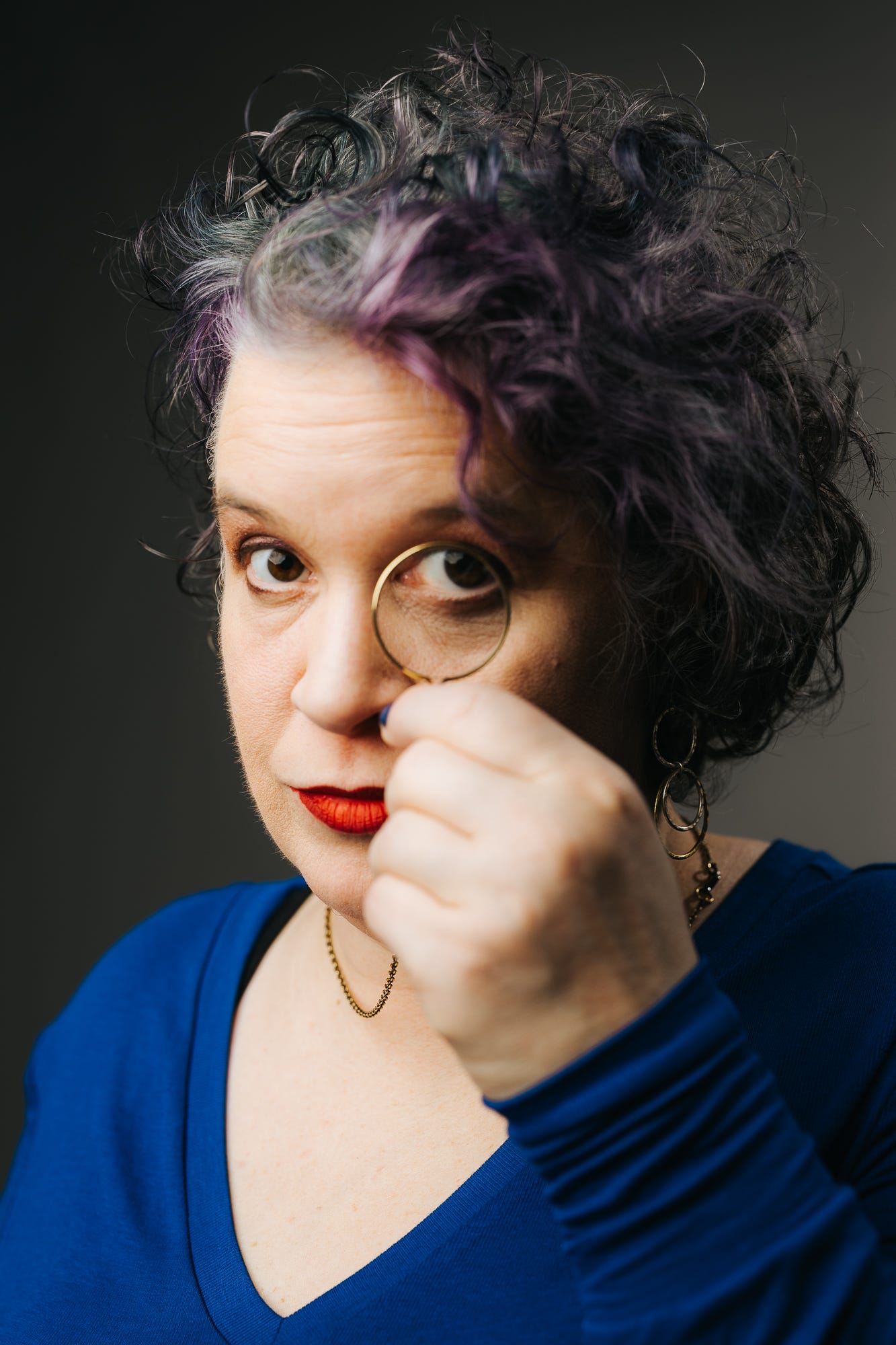
Bridget Kriner is a community college professor in Cleveland, Ohio, where she teaches English and Women’s & Gender Studies. Her work has appeared in The Shore, Variant Literary, New Delta Review, Rattle Poets Respond, and Split this Rock, where she won First Place in the Abortion Rights Poetry Contest. Over the last several years, she has participated in the Sewanee Writers’ Conference and Kenyon Review Summer Residential Workshop. She is a supporting editor at Trio House Press and a reader at Chestnut Review and Only Poems! Over the course of her working life, she has worked as a barista, bartender, abortion clinic patient advocate, union organizer, and fair housing tester.
A little over a year ago, Trio House editors Kris and Natasha offered me the chance to work on Emily Hyland’s forthcoming collection, My Wise Little Ghost, as a secondary editor. If I am being completely honest, I was equally thrilled and terrified about this opportunity. Sure—I was a tenured writing professor with 15 years of experience teaching composition and creative writing, and had served as the Poetry Editor for the student literary magazine in grad school. Still, editing a poetry collection was something new, and I wasn’t so sure I knew enough or was poet enough to handle this level of responsibility (probably on account of a chronic, intractable case of imposter syndrome, but that is another story, far beyond the scope of this reflection). As is often the case, my self-doubts were concealing all of the possibilities inherent to this opportunity–namely, everything I could learn. What follows are a few of my reflections on what it meant to be a part of bringing a fellow poet’s book into the world and what I have learned (so far).
A poetry collection is more car than wheel
In other words, a poetry collection is a whole thing on its own, not just an accumulation of individual poems. This distinction is one that I don’t think I ever truly understood until I worked with Natasha and Emily on this first collection. While I had read a great many poetry collections, I can say now that I didn’t fully understand the difference. What finally clicked for me is that a poetry collection is a singular entity unto itself that is intended to be read as a cohesive whole. A single poem, too, is a whole thing unto itself—its own little universe of meaning and discovery. However, when this one single little universe becomes part of a poetry collection, it is transformed. It is no longer on its own, it is part of a team. It becomes a part of something completely new. It’s that completely new entity that I had to understand with more clarity as a poetry editor—I had to take a step back until I could see how all the poems were functioning together.
In the car-wheel analogy, a poetry collection is like a car—a complex mechanism in which many different parts work together to make the car go somewhere. As such, the individual poems are the car’s individual components—wheels, engine, carburetor. A reader is the car’s driver. Just as the driver of an actual car can drive it without necessarily having a complete understanding of what is under the hood, a reader can maneuver through any book just fine without knowing exactly how to write one.
A poetry editor is a reader
A poetry editor is first and foremost a reader—but importantly, a poetry editor is a reader who reads both the lines of the poems and what lies between them (and also what is between the poems themselves, between the sections, and between the first poem and the last one). I learned that instead of looking closely at each single poem for what it did and what it might offer a reader, I had to pay close attention to these other less visible spaces in the collection.
To offer another analogy—a poetry collection is like a completed jigsaw puzzle, while the poems inside are the puzzle pieces. Here, what a poetry editor considers are the junctures where the pieces join and the ways the shapes and lines form the puzzle’s structure. Everything must fit together. It is worth noting that unlike a jigsaw puzzle, a poetry collection could be assembled successfully in many different ways. But there lies another observation I made about the job of an editor—to consider the way the poet assembled their poems, how that particular organization (as opposed to another possible sequencing) is working, and what a reader might take away.
Being a poetry editor is a human interaction
Perhaps this thought would have been less salient to me a few years ago—back before LLMs figured so largely into writerly questions about process and authorship. But given that this is where we are, it feels important to emphasize—working as a poetry collection editor is not a job, it’s a relationship between humans. And all the conventions of human-to-human relationships apply—e.g., listen more than you talk. Listen to the poems very closely—what are they saying or trying to say? Listen to the poet—what do they hope a reader will see and know in the experience of their collection?
Recognizing the necessity of humanity in the process reaffirmed something essential to me about poetry—at its core, it cannot be synthesized by an algorithm or refined (revised, edited) by Silicon Valley innovation. In short, writing poetry cannot be outsourced; it’s the nuance, the context, the particularity of the poet’s voice—these are not replicable by technology. The same is true for the work that happens in the relationship between poet and editor, and no AI or LLM can replace a human being in this role.
What I came to understand is that my role in the process was not to provide answers—it was to ask questions. It was not to impose my own personal aesthetic on the collection. Or rewrite it. It was to reflect back to the poet what I heard and saw –as one reader–in my experience of reading this one book. I discovered how absolutely thrilling it was to be a part of bringing another poet’s book into the world! I had not considered how meaningful it could be to be part of the conversation about poetry—a poetry collection poised to be held in the hands of readers everywhere.
 | A guest post by
|
I love the idea of the editor as an audience member relaying their experience and posing further questions. And yes, I love how the strongest collections tell a story in how the poems talk amongst themselves.
Love this, Bridget. This passage in particular: "What I came to understand is that my role in the process was not to provide answers—it was to ask questions. It was not to impose my own personal aesthetic on the collection. Or rewrite it. It was to reflect back to the poet what I heard and saw –as one reader–in my experience of reading this one book." As well as the idea of the poems having to work together in dialogue, in addition to working on their own. Great insights!